

Fitness foundations
Desired outcome: Build the mobility, strength, endurance, and cardiovascular capacity needed to tolerate bodyflight while reducing avoidable strain on injury-prone areas.
The IBA program emphasizes the back, core, knees, and shoulders. These areas must tolerate repeated flying as well as the demands of spotting and supporting other flyers. The program can supplement an existing three- or four-day fitness routine or provide a starting point for someone who is not training regularly.
The exercises require only a basic weight room. Cable movements can usually be adapted to resistance tubing or bands, with repetition targets adjusted for the available resistance. If equipment or a safe alternative is unavailable, ask a qualified fitness professional for an appropriate substitution.
General guidelines:
- Warm up properly before exercise or tunnel training.
- Do not work through pain. Stop the exercise and have the problem assessed by a qualified professional.
- Use a full, controlled range of motion, or the greatest pain-free range you can perform safely. Reduce the resistance if weight or discomfort prevents good movement.
- Bodyflight uses unusual and sometimes extreme joint positions. Develop strength throughout the usable range instead of loading only the middle of a movement.
- Soreness is not the goal of every workout. Excessive soreness increases the recovery time required before the next session.
- Respect fatigue and recovery. The body is the flyer's primary piece of equipment and must be maintained for long-term participation.
This material is general conditioning guidance, not an injury diagnosis or an individual exercise prescription. Scale every movement to current ability and seek professional guidance when health, pain, technique, or equipment creates uncertainty.
Warm-up routine
The source routine is intended to be quick but thorough. Use it before a workout, before tunnel training, or periodically during a physical workday to keep the joints and major movement patterns prepared.
Walking warm-up series:
- Knee pulls: Step forward, hold the knee or shin, and draw the thigh toward the chest while remaining upright. Pause briefly, release, and alternate legs.
- Quad pull and reach: Reach behind for the opposite foot and draw it comfortably toward the glutes. Stand tall, reach the free hand overhead, rise onto the toes, release, and alternate sides.
- Lunge rotations: Step into a lunge and rotate the trunk toward the lead leg, reaching the same-side arm behind. Return to neutral, stand, and repeat on the other side.
- Inchworms: From standing, hinge forward and place the hands on the floor. Walk the hands to a plank while keeping the legs as straight as practical, take small steps until the feet reach the hands, then stand and repeat.
Mat warm-up series: Perform 10-15 controlled repetitions on each side where applicable.
- Fire hydrants: From hands and knees, brace the core and keep the back and hips level while raising one bent leg to the side. Return with control.
- Kickbacks: From hands and knees, keep the core braced and back level while driving one bent leg behind the body. Return with control.
- Lateral leg kicks: Extend one leg behind from hands and knees, move the straight leg from the rear to the side without setting it down, then return it behind the body.
- Supermans: Lie face down with the arms extended. Raise the arms and legs together into a controlled arch, hold for a two-count, and lower.
- Figure-four rockers: Lie on the back and rock the legs overhead. Rock forward with one leg extended and the other bent into a figure four, reach toward the extended foot, then rock back and alternate.
- Opposite arm and leg: From hands and knees, extend one arm and the opposite leg into a level line. Hold for a two-count, return, and alternate.
Remaining warm-ups:
- Overhead squat series: Squat from a shoulder-width stance and touch the floor. Raise one arm overhead, then the other, before standing from the squat.
- Reverse flutter fly: Anchor a resistance band around chest height, draw the arms behind the body just below shoulder height, and perform small, controlled backward-and-forward pulses.
- Reverse band fly abduction: With the band anchored at chest height, draw the hands toward the sides of the hips with palms forward. Maintain the arms behind the torso while tracing a slow arc overhead, then return through the same path.
Conditioning exercise library
Select resistance and repetitions that permit stable, controlled technique. Power exercises, loaded hinges, and unfamiliar equipment should be introduced with qualified instruction and an appropriate progression.
Core and trunk:
- Five-minute abs: Change core exercises every 30 seconds for five minutes without a rest interval.
- Ab heel touches: From a supported crunch position, alternate reaching the fingertips toward each heel without pulling on the neck.
- Cable or band crunches: Kneel while holding a high cable or anchored band beside the head, then draw the ribs toward the pelvis without using momentum.
- Reverse crunches: Begin with hips and knees near 90 degrees and draw the knees toward the chest, lifting the pelvis without swinging.
- Planks: Hold a straight line from shoulders through the hips without allowing the pelvis to sag.
- Side planks: Support the body on one elbow and maintain a straight line while keeping the hips forward and chest open.
Lower body and posterior chain:
- Band walks: Maintain band tension while stepping sideways. Lift each foot instead of dragging it across the floor.
- Box jumps: Use a stable platform at a safely attainable height. Jump from a controlled squat and step down.
- Deadlifts: Lift the resistance from the floor with a steady, controlled hinge and a braced, neutral back.
- Straight-leg deadlifts: Hinge at the hips with straight or softly unlocked legs, a braced back, and an appropriate load.
- Glute bridges: Place the heels on a stable bench or box and lift the hips until the trunk forms a straight, braced line.
- Hyperextensions: Brace the lower body and extend the hips and back through a controlled, pain-free range without throwing the torso.
- Lunges: Step into a stable lunge with bodyweight or an appropriate load. Without weight, the guide suggests pausing at the top with the free knee raised.
- Lunge jumps: Begin in a lunge, jump and switch the legs in the air, then land under control before repeating.
- Squats: Use a bodyweight, dumbbell, barbell, or front-squat variation that can be performed through a stable, pain-free range.
- Squat jumps: Jump from a deep, controlled squat and land quietly by absorbing the force before the next repetition.
Upper back and shoulders:
- Dumbbell rows: Establish a stable base with one hand supported, then draw the weight from below the shoulder toward the side without rotating the trunk.
- Pulldowns: Use a bar or two independent handles and pull down through the same pattern as a controlled pull-up.
- Push/pull: Hold dumbbells through a push-up, then stabilize at the top and row one side. Alternate the rowing arm after each push-up.
- Reverse flys: Lie face down on an incline bench and raise light weights to the sides with controlled, nearly straight arms and no swinging.
- Rows: Draw cable, suspension-trainer, or bar handles toward the chest while keeping the torso stable.
- Shoulder raises: Lift one or both arms with a load that does not require swinging, keeping the shoulders controlled rather than shrugged.
- Plate raises: Hold a plate or similar resistance with mostly straight arms and raise it overhead under control.
Cardiovascular conditioning:
- Tabata drill: Complete 20 seconds of hard effort followed by 10 seconds of rest for the planned number of sets. The guide suggests a treadmill, bicycle, or running, but the modality should match the athlete's ability and training environment.
- Steady cardio: Use continuous cardiovascular work to build the endurance needed for repeated flight rotations and recovery between them.
Eight-week training structure
The source guide provides an eight-week program organized across four training days. It progressively adjusts repetitions, timed holds, interval sets, and cardio duration. The schedule combines the exercise library above with push-ups, pull-ups, curls, triceps pushdowns, leg presses, step-ups, hamstring curls, leg extensions, and plyometric push-ups.
Day 1 - Upper body, trunk, and steady cardio:
- Push-ups, pulldowns, pull-ups, curls, and triceps pushdowns.
- Planks, side planks, ab heel touches, and cable or band crunches.
- Hyperextensions, shoulder raises, and reverse flys.
- Continuous cardio, beginning at 20 minutes in the guide and building to 30 minutes in the later weeks.
Day 2 - Full-body strength and power:
- Leg presses, rows, pull-ups, and deadlifts.
- Plyometric push-ups, squat jumps, and step-ups.
- Tabata intervals and a five-minute abdominal circuit.
Day 3 - Lower body, trunk, and steady cardio:
- Squats, lunges, straight-leg deadlifts, hamstring curls, and leg extensions.
- Box jumps, squat jumps, band walks, and glute bridges.
- Hyperextensions, cable or band crunches, and side planks.
- Twenty minutes of continuous cardio in the source schedule.
Day 4 - Posterior chain, power, and trunk:
- Deadlifts, straight-leg deadlifts, hyperextensions, and glute bridges.
- Supermans, lunge jumps, reverse flys, plate raises, and push/pull rows.
- Reverse crunches, planks, and a five-minute abdominal circuit.
- Tabata intervals.
The published schedule increases several targets across Weeks 1-8. Examples include planks progressing from 35 to 45 seconds, Day 1 cardio progressing from 20 to 30 minutes, and Tabata work progressing from five to seven sets. These are source-program targets, not requirements for every flyer. Maintain good form, allow sufficient recovery, and adjust the plan with a qualified professional when the published workload does not match current readiness.
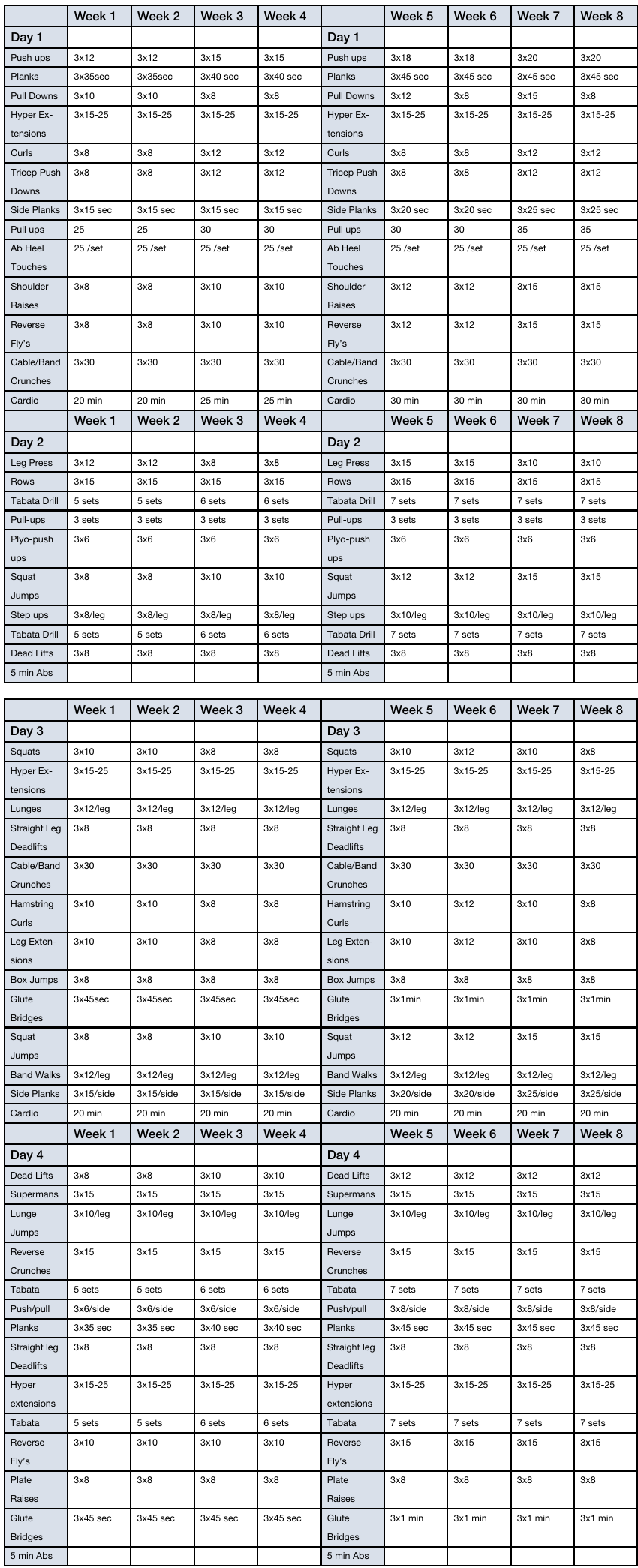
Source: IBA Wind Tunnel Fitness Program, developed with Axis Performance.